
Design · 2026-10-14
Can a watch be both solar and automatic? Inside the rare hybrids that actually exist
Yes—but not the way most people think. From Ressence's solar-powered e-Crown on a self-winding mechanical watch to Technik 4X's twin automatic and solar-quartz dials, we investigate two real approaches, four watches and the solar-mainspring future.
Save this watch to revisit later.
Share this article
By Chronolume digest · Original English summary · Based on Chronolume original research using Ressence, Technik 4X and Seiko manufacturer documentation and EP3299908B1 patent
What to know
CAN ONE WATCH RUN ON SUNLIGHT AND AN AUTOMATIC MOVEMENT? The short answer is yes—but not in quite the way the words suggest. Most solar watches have an electronic quartz movement, while a conventional automatic watch stores the wearer's movement as tension in a steel mainspring. Combining them requires an explicit choice: put two independently powered movements in one case, or preserve mechanical timekeeping and let sunlight run a supplementary electronic system. Rare commercial watches have demonstrated both approaches. The result is more interesting than a vague claim that a mechanical movement 'charges by solar power.'
THE ENERGY QUESTION. A traditional self-winding watch gets energy from the motion of an oscillating rotor, which winds the mainspring through a gear train. A solar watch uses photovoltaic cells to turn light into electric current, charging a rechargeable cell that operates a quartz movement. These energy flows are not interchangeable: photons generate electricity, not mainspring tension. For sunlight to wind an ordinary mechanical calibre, an extra motor or other electromechanical mechanism would have to convert the electricity back into mechanical work. It is technically plausible—and the subject of patents—but it is not the established architecture of the examples considered here.
APPROACH ONE: TWO WATCH MOVEMENTS, ONE CASE. Technik 4X's Auto-Solar ASD-44 range makes the combination literal. A Seiko Instruments NH05B automatic movement sits alongside an Epson VS17A solar-quartz movement. Each drives its own dial, so the two can be set to different time zones. The automatic uses a rotor and runs for more than 40 hours when fully wound; the quartz side converts light into energy and, according to the maker, can run for roughly six months in darkness after a full charge. The power sources are separate. Even if the automatic side winds down in a drawer, the solar display may continue to show the correct time.
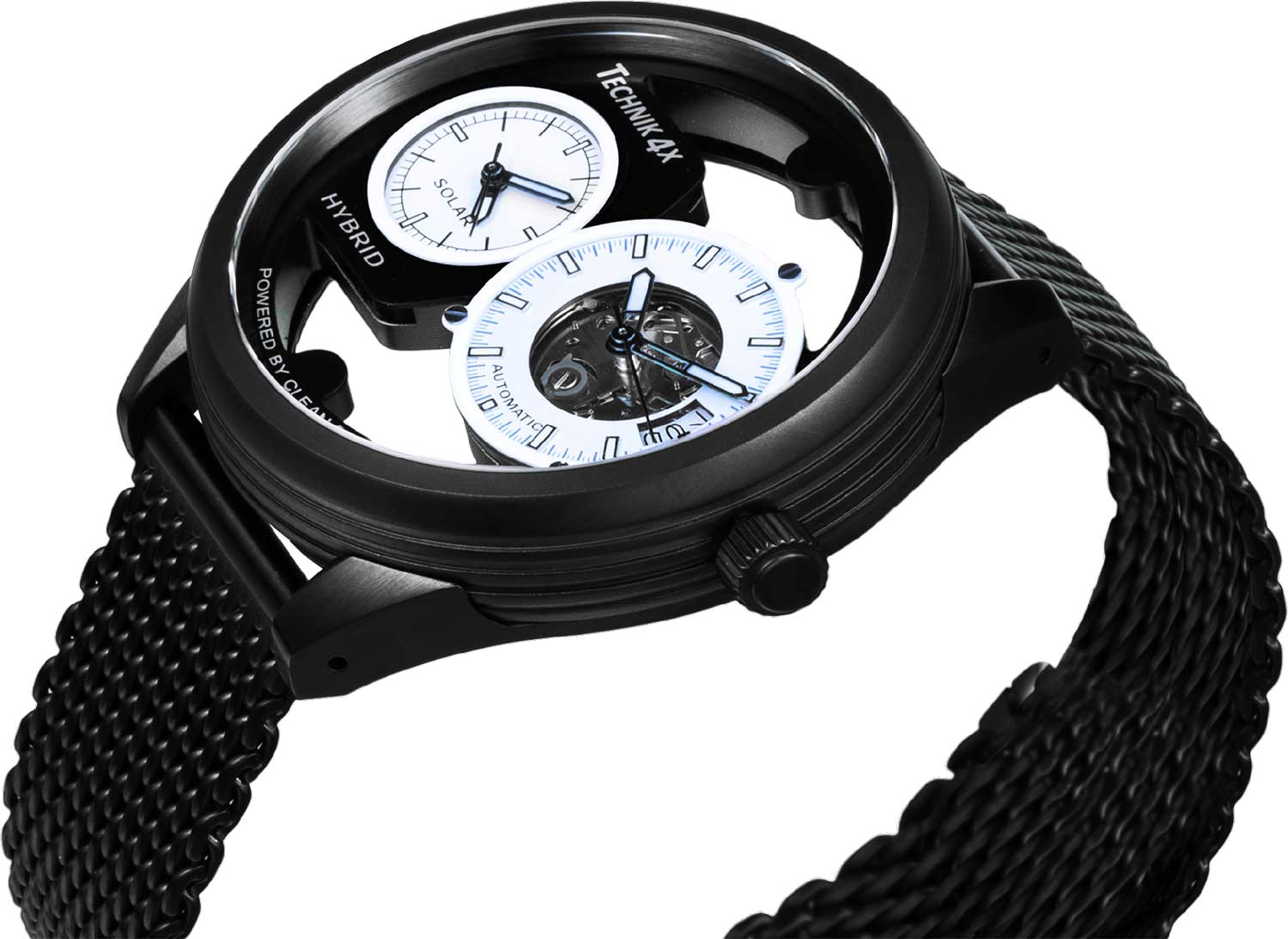
DESIGN STUDY: TECHNIK 4X SKELETOR. The black-and-white Skeletor [ASD44-SKE.BKBK.BKWH] turns that two-system engineering into its graphic identity. The smaller left face says SOLAR; the openworked right face says AUTOMATIC. Instead of hiding the difference behind a familiar single-hand display, the watch asks its owner to appreciate the coexistence of quartz precision and a mechanical escapement. Large sculpted voids, luminous blued hands, a dark steel case and an exhibition back reinforce the impression of a laboratory instrument. At 44.5 mm wide and 11.45 mm thick, it is visually bold rather than minimal. Separate Chronolume watch profile: https://chronolume.page/article/technik-4x-asd44-skeletor-black-white-auto-solar
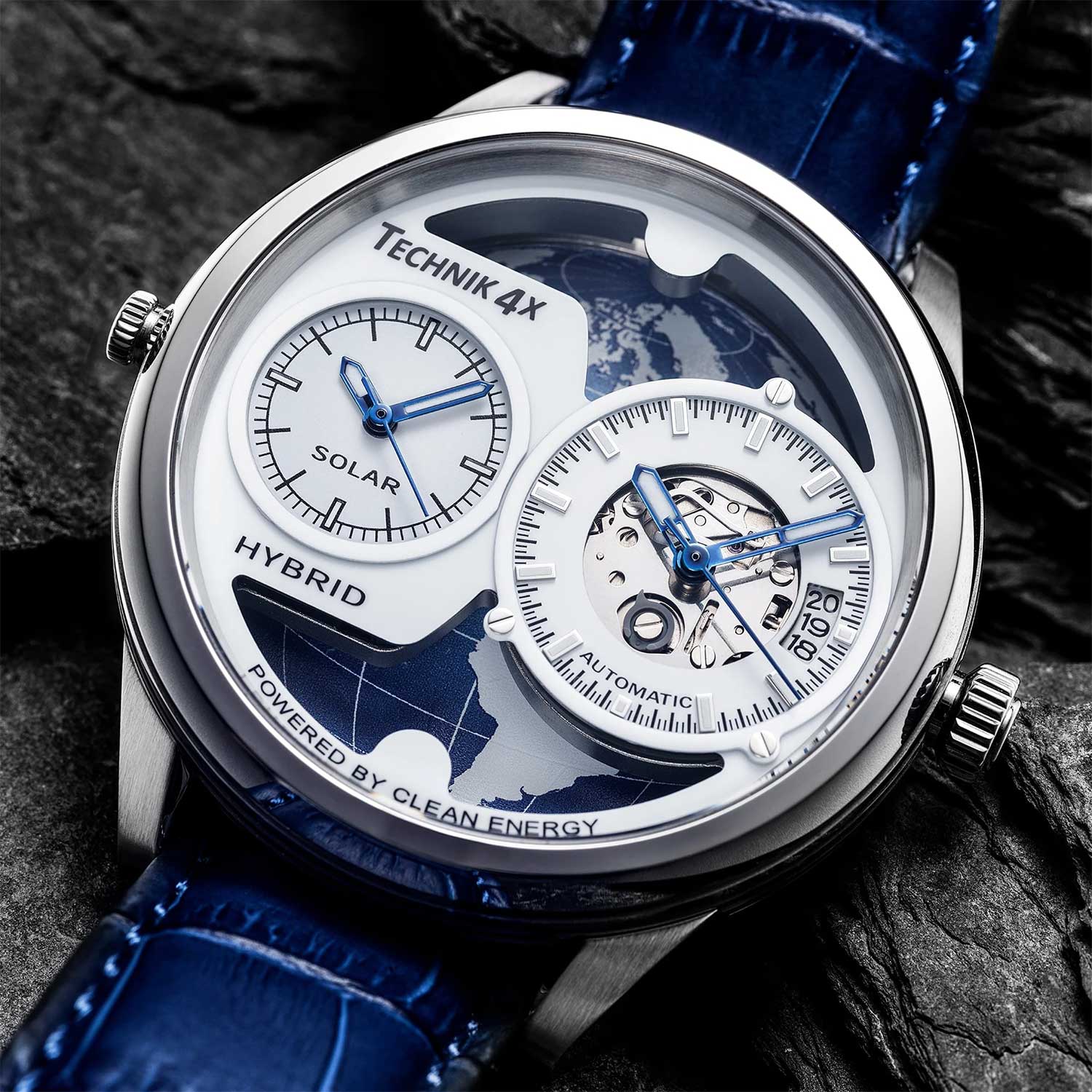
DESIGN STUDY: TECHNIK 4X GLOBE. The White + Blue Globe [ASD44-GLO.SVSV.WHWH.BL] uses the same Japanese movements but interprets their two time zones through a decorative illuminated globe. The solar display is positioned at left, the semi-skeletonised automatic display at right, while blue land masses appear above and below the dials. This makes the two energy systems feel less like competing demonstrations and more like a travel narrative. The globe can glow in low light, creating a visual link between the different displays. Its attractive contradiction is that a world-travel watch expresses global time zones through two complete movements rather than a standard GMT hand. Separate profile: https://chronolume.page/article/technik-4x-asd44-globe-white-blue-auto-solar
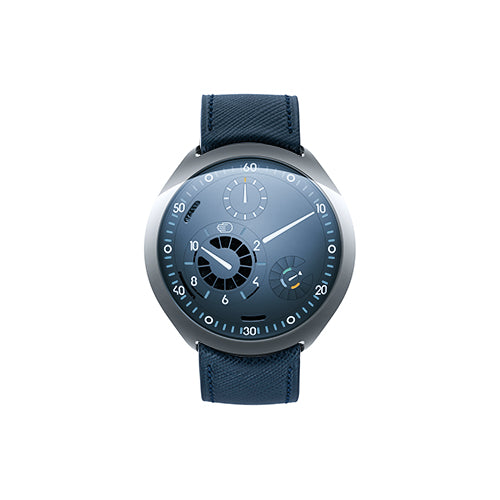
APPROACH TWO: A MECHANICAL WATCH WITH A SOLAR-POWERED BRAIN. Belgium's Ressence asks a subtler question. What if a mechanical watch could behave like a modern connected device without surrendering its mechanical soul? The answer was the Type 2 e-Crown. First shown as a concept in 2018 and released in production form in 2019, it uses a customised self-winding 2892/A calibre to move Ressence's orbital ROCS 2 time display. The base movement remains mechanical. A separate electronic module, the e-Crown, is supplied with energy by a system that includes photovoltaic cells hidden under micro-shutters in the dial. Solar power serves the system that checks and restores correct time and manages settings; it is not the ordinary source of power for the escapement.
THE MOST INTERESTING DETAIL: MICRO-SHUTTERS. The Type 2 does not place a large black solar panel on its face. Ressence integrates custom photovoltaic cells in and around a satellite subdial, including cells beneath ten tiny shutters that can expose the solar surfaces as required. That is remarkable interface design. Instead of treating harvesting sunlight as something the user must see or actively manage, the system embeds the energy hardware within the normal dial architecture. The owner taps the sapphire crystal to engage its controls and can choose between stored time zones, while the watch's mechanical operation continues independently if the e-Crown is switched off.
WHY THE e-CROWN MATTERS. Put an ordinary automatic in a drawer long enough and it stops; the wearer must reset it before it can be useful again. Ressence can pause its mechanical movement while not being worn, retain the time digitally and then adjust the display to the correct reading on reactivation. It can also interact with an app for time-zone selection. The deeper product-design story is not about adding a screen to a mechanical watch. It is about removing friction from the act of owning one, while leaving the emotional centre—the gear train, escapement and mainspring—mechanical.
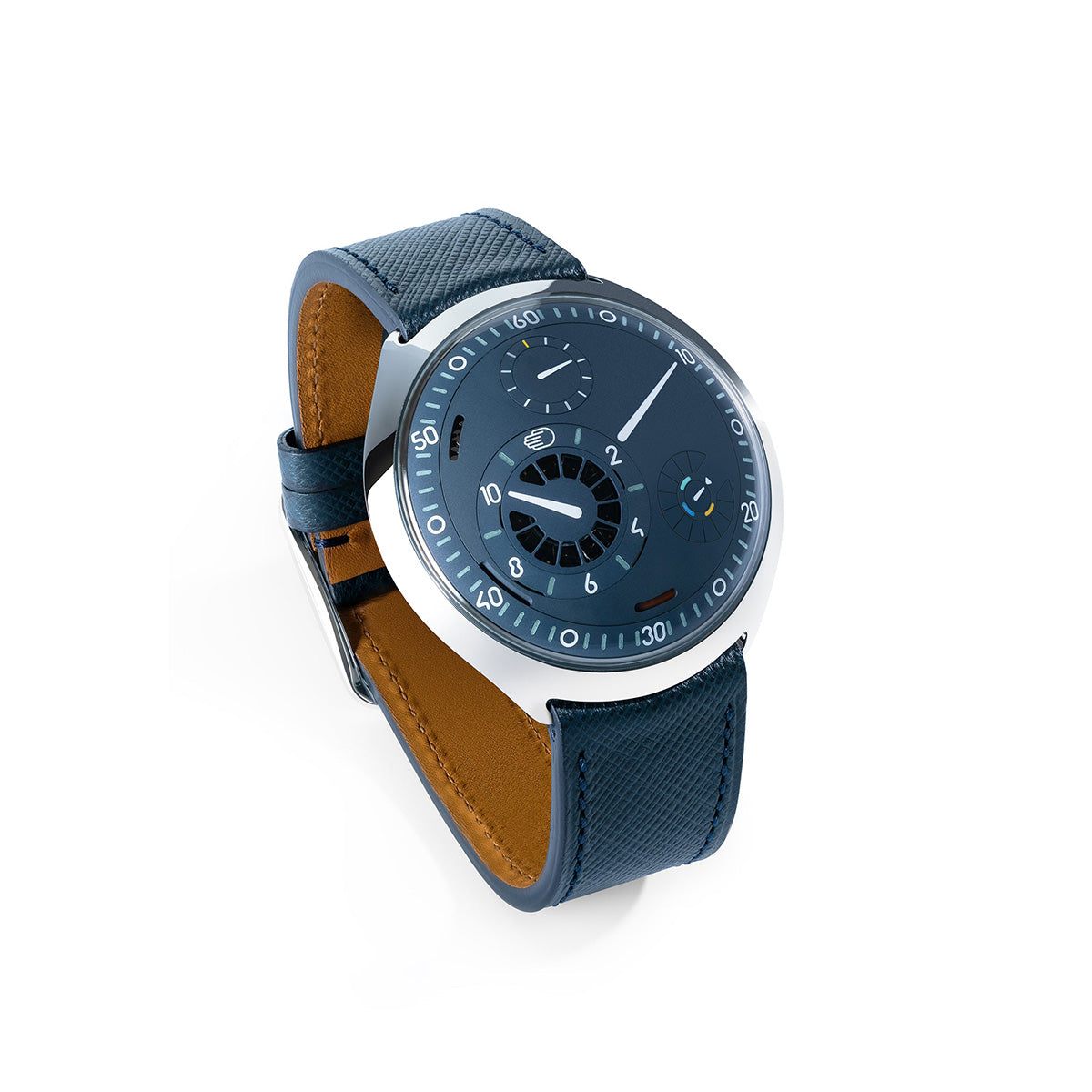
DESIGN STUDY: RESSENCE TYPE 2 NIGHT BLUE. Type 2 N wraps the hybrid concept in a 45 mm grade 5 titanium case with a deep-blue convex dial, satellite indicators and a matching leather strap. The surface has no ordinary crown and no traditional central hand stack. The e-Crown selector appears as one orbiting display among the others, and the solar micro-shutters are elegantly integrated. Its automatic calibre has a 36-hour reserve. Ressence currently shows the watch at €61,900 including VAT and marks it sold out. This is a 2019-era mechanical-electronic architecture, not a newly released 2026 invention. Separate profile: https://chronolume.page/article/ressence-type-2-night-blue-solar-ecrown-mechanical
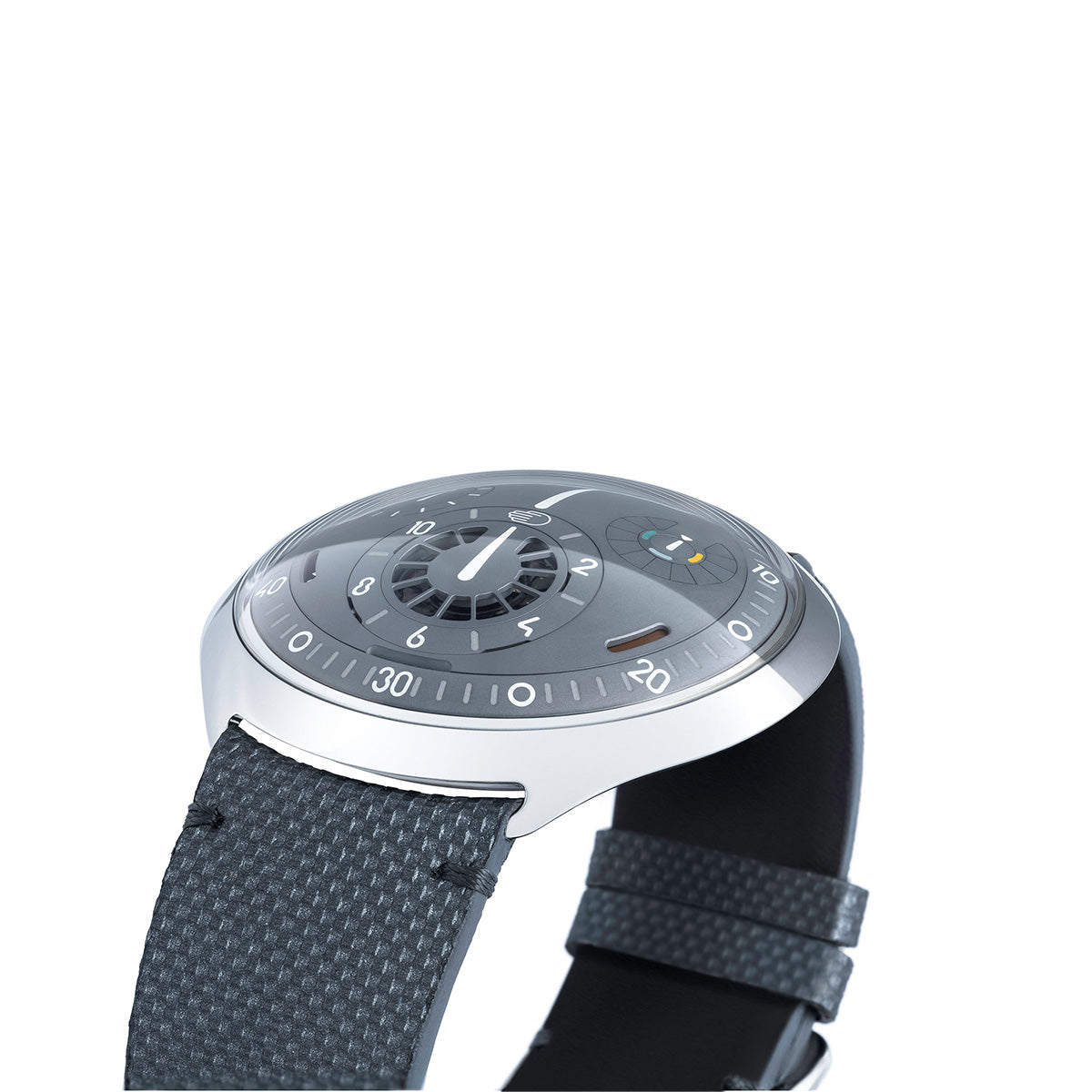
DESIGN STUDY: RESSENCE TYPE 2 GREY. In monochrome grey, the same 45 mm Type 2 platform becomes more architectural still. Tilted satellite discs seem to float within one curved field, creating a display almost without a boundary between surface and mechanism. Solar technology is present but almost invisible, while the interface behaviour—tap to activate, automatic time correction, saved time zones—is intentionally effortless. It is a particularly telling example of the difference between a watch that looks electronic and one that quietly uses electronics to improve a mechanical product. Ressence lists the Grey at €61,900 including VAT, sold out. Separate profile: https://chronolume.page/article/ressence-type-2-grey-solar-ecrown-mechanical
THREE COMMON MISCONCEPTIONS. First, Seiko Kinetic is not a conventional automatic watch: its rotor generates electrical energy for electronically regulated quartz timekeeping rather than winding a mechanical mainspring. Second, Grand Seiko Spring Drive is driven by a mainspring, with electronic regulation of the glide wheel, but it is not solar-powered. Third, some manufacturers, including Victorinox's Concept One range, offer 'solar' and 'automatic' versions of similar-looking watches. Those are separate watches with different movements, not a combined movement. The phrase 'solar automatic' on its own is therefore not enough to establish a hybrid mechanical architecture.
COULD SUNLIGHT REALLY WIND THE MAINSPRING? In principle, yes. Patents such as EP3299908B1 describe an electric winding device powered by a photovoltaic cell that could supplement or replace the wearer's movement as the source of mainspring-winding energy. The concept uses the electricity to turn a motor, which then delivers mechanical winding work to the barrel. This is conceptually different from both Technik 4X's two independent timekeepers and Ressence's solar e-Crown. A patent establishes a claimed mechanism, not proof of a commercially released wristwatch, so it should not be listed alongside confirmed retail watches without product verification.
THE DESIGN TRADE-OFFS. Two complete movements provide genuine independence and can tell two time zones, but they demand more space, two setting interfaces and the servicing needs of both an automatic movement and a rechargeable electronic system. Ressence's integrated approach is visually cleaner, but its custom electronics, batteries, shutters and proprietary mechanics add engineering complexity and potential future-service considerations. Nor does sunlight make either approach maintenance-free: photovoltaic cells harvest energy, while rechargeable storage components and conventional mechanical lubricants still age.
WHY THIS MATTERS FOR WATCH DESIGN. These watches reject the assumption that 'mechanical' and 'digital' must be mutually exclusive categories. The most successful hybrids are not the ones that bolt extra technology onto a dial. They assign technologies clear jobs: a mechanical oscillator for emotional and tactile continuity; sunlight for long-term low-power electronics; a user interface that explains—or deliberately conceals—the division of labour. The next breakthrough could be a discreet solar motor that genuinely winds a mechanical mainspring when a watch is left on a desk. Until then, the most compelling real watches show us that two forms of energy can coexist without pretending they are the same.
SOURCES AND CHECKS. Manufacturer technical descriptions: Ressence TYPE 2 and e-Crown (https://ressencewatches.com/pages/type-2 and https://ressencewatches.com/pages/e-crown); Technik 4X auto-solar specifications (https://www.technik4x.com/specification/spec-auto-solar-watches/); Seiko's own comparison of Kinetic, Solar, Spring Drive and mechanical watchmaking (https://seiko-cleanenergy.com/watches/index.html); European patent EP3299908B1 (https://patents.google.com/patent/EP3299908B1/en). The four pictured examples are existing products, not October 2026 launches. Prices and stock were checked on 14 October 2026 and may change.
At a glance
| Topic | Watch movement design: solar plus automatic |
|---|---|
| Real combined approaches | Independent mechanical and solar-quartz movements; mechanical movement with solar-powered electronics |
| Confirmed example watches | Ressence TYPE 2 N, Ressence TYPE 2 G, Technik 4X ASD44 Skeletor Black/White, Technik 4X ASD44 Globe White/Blue |
| Important distinction | Solar cells do not directly wind the mechanical mainspring on the featured watches |
| Published | 14 October 2026 |
Explore the watches
Ressence TYPE 2 Night Blue · TYPE 2 Night Blue ↗
Technik 4X ASD-44 Skeletor Black/White · ASD44-SKE.BKBK.BKWH ↗
Technik 4X ASD-44 Globe White/Blue · ASD44-GLO.SVSV.WHWH.BL ↗
Source & attribution
Related perspectives
YEMA Granvelle Renaissance CMM.29: architecture under sapphire ↗
YEMA Superman Bronze CMM.10 lets the diver age with its owner ↗
IWC's black-ceramic TOP GUN turns the pilot chronograph into a stealth instrument ↗